

A Closer Look – The Military and Vaccines: A Shot in the Army
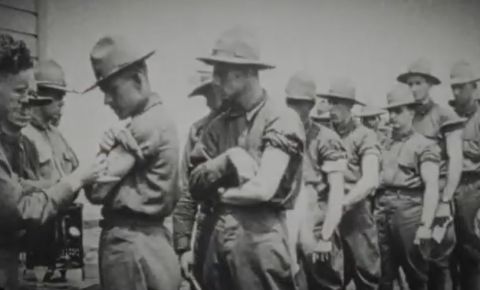
In North America, some of the earliest examples of the interplay of infectious disease and warfare include the use of smallpox and other diseases to push Native Americans out of areas deemed desirable by the settlers. During the American Revolution, it was suspected that the British used smallpox as a biological weapon, causing cases of the disease to cripple the Continental Army. In response to the growing casualties associated with smallpox, in May of 1776, General Arnold ordered that his troops be inoculated, an early precursor to vaccination. Two years later, General Washington issued a similar order to protect the Continental Army from smallpox. Fast forward to 1918 and World War I, influenza virus ravaged troops around the world. In fact, the 1918 flu was given the nickname “Spanish Flu” because Spain, a neutral country in the war, was one of the only countries accurately reporting their case counts. Most countries were not honestly reporting their influenza cases because they didn’t want their enemies to know their troops were weakened. The end result was that people came to believe the pandemic began in Spain. Countless examples of the impact of infectious diseases on military conflicts can be found throughout history. So, let’s take a look.
The Perfect Environment for Pathogens to Spread
Until World War II, the majority of deaths in military units engaged in combat were due to infectious diseases, not battle wounds. This was related to the environment:
- Troops were housed in close quarters.
- They were regularly exposed to unsanitary living conditions, both in training facilities as well as during deployments.
- They traveled from camp to camp or camp to home, spreading diseases along the way.
Even today, infectious diseases are a concern for the U.S. military. While sanitation has greatly improved, soldiers still live in close quarters, and recruits and personnel come from all over the country, bringing an array of germs with them. Likewise, troops are deployed around the world, setting the stage for exposure to pathogens they would not normally encounter in the U.S. Illness among personnel can lead to increased training time, decreased mission readiness, and higher medical costs. As such, efforts to prevent illness among troops remain a high priority for the military. One way to keep troops healthy is through prevention, such as vaccination. To protect troops, the U.S. military has a long history of funding and conducting research to develop vaccines of military importance. The military has also enacted vaccine mandates to ensure personnel receive the vaccines necessary to protect themselves and those around them.
Historical Vaccine Development and Use by the U.S. Military
While many vaccines have been developed to prevent illness among troops, several have benefitted the general public. Three examples of the military’s contributions to vaccine development include vaccines against influenza, meningitis and adenovirus.
Influenza: The military’s need for a flu vaccine was exemplified during WWI. The 1918 flu resulted in 20 to 40 of 100 U.S. Army and Navy personnel getting sick. Around half of the deaths of American soldiers during WWI have been attributed to flu and pneumonia. In 1941, remembering the effects of the 1918 flu on U.S. troops, the Board for the Investigation and Control of Influenza and Other Epidemic Diseases in the Army (later called Armed Forces Epidemiological Board) was established to aid in the quest for a vaccine against influenza. Scientists in military labs diligently studied the virus and vaccine development.
During the 1940s, the military’s focus on influenza led to the development of the first flu vaccine and our understanding of antigenic shift and drift. In 1943, a clinical trial using a killed whole-virus flu vaccine demonstrated efficacy in preventing disease. Later that year, before being licensed, the vaccine was used in U.S. forces due to fears that troop movements in WWII would cause another pandemic. By 1945, the vaccine received approval and the military issued its first flu vaccine mandate. Four years later, the mandate was withdrawn due to waning immunity. Dr. Maurice Hilleman, working in a U.S. military lab at the time, figured out that the loss of effectiveness was due to the virus changing. By comparing different circulating strains of influenza, Dr. Hilleman was able to identify minor seasonal changes as antigenic drift, and major changes that could cause pandemics as antigenic shift. Once the seasonal antigenic changes were understood and vaccines could be adjusted to account for these changes, the military reinstated its flu vaccine mandate. The annual influenza vaccine is still required for all active duty and activated reserve personnel (unless they have a medical or administrative exemption). Vaccination rates among the troops are over 90%. Even though the flu vaccine was developed to benefit the military, it protects the general public as most people 6 months of age and older are recommended to get this vaccine annually. Unfortunately, while the influenza vaccine has been shown to prevent serious illness and death in about 70 of every 100 people who get it, only 47 of 100 adult civilians got the flu vaccine during the 2024–2025 flu season, one of the most severe seasons in recent memory.
Meningococcal Meningitis: Meningococcal meningitis is caused by a bacteria known as Neisseria meningitides. Infection with N. meningitides can cause sepsis, which is a bloodstream infection, and meningitis, which is a swelling of the brain and spinal cord. An infection with meningococcal bacteria can be fatal in hours. Meningococcal meningitis erupted in U.S. troops during WWI, and a similar experience was predicted during WWII. So in 1941, the Army created the Commission on Meningococcal Meningitis to combat the disease. Over the next two years, between 1941 and 1943, 5,000 cases of meningococcal meningitis were reported in soldiers. Most infections occurred within a recruit’s first three months of service. During the Vietnam War, without a vaccine available for meningococcal meningitis, epidemics occurred across U.S. military basic training centers, leading to 2,400 cases with 170 of those with symptoms succumbing to infection. These outbreaks intensified the military’s efforts to develop a vaccine.
Military scientists eventually developed a subunit polysaccharide vaccine against one type of the bacteria, and in 1970, the vaccine (group C) became routine for recruits entering basic training. Over time, vaccines that included other polysaccharide groups also became available. Today, vaccines against all five types of this bacteria are now available and routinely administered to military recruits. Likewise, the public also benefits from routine recommendations for meningococcal vaccine among high-risk individuals as well as for adolescents and teens.
Adenovirus: In 1952, scientists were investigating influenza infections at Fort Leonard Wood; however, after collecting samples from infected soldiers, Drs. Maurice Hilleman and Jaqueline Werner discovered that the virus they isolated was not influenza but rather a newly identified respiratory virus later named adenovirus. Dr. Hilleman went on to develop an adenovirus vaccine that protected recruits from this infection that had often caused entire classes of recruits to repeat their training because so many were infected and too ill to attend training sessions. Dr. Hilleman’s vaccine was later replaced by an oral vaccine, and by 1971, the military had an adenovirus vaccine program. The result: adenovirus disease disappeared from recruitment centers.
However, in 1984, the single company that made the adenovirus vaccine, Wyeth Pharmaceuticals, requested $5 million to upgrade their vaccine production facility. Unfortunately, because the vaccine worked, and, therefore, disease was no longer common among recruits, the funds were not approved and by 1999, vaccine supplies ran out. As many scientists could have predicted, adenovirus infections increased dramatically causing illness in about 15,000 recruits per year and costing about $26 million annually. By 2001, the military entered into a new contract to produce the adenovirus vaccine, but it took 10 years and $100 million for the new vaccine to become available. Sadly, during the period when an adenovirus vaccine was unavailable, eight military recruits died from adenovirus infections.
While the adenovirus vaccine is only available to military personnel, the lesson remains that when a vaccine is highly effective, cases of the disease will dwindle. This does not mean the pathogen is gone or that the vaccine is no longer needed, it means the vaccine is working. The military’s adenovirus vaccine story demonstrates the importance of continued vaccination if a pathogen is still present, but infections and disease are uncommon.
Learn more about the adenovirus vaccine story in the film, “Forgetting to Remember – Lessons from a Vaccine Lost."
The Military and Vaccines Today
Infectious diseases will continue to be a foe of citizens and our troops. And, given that our troops can be exposed to pathogens not common in the U.S., the military will have an ongoing interest in how to protect our troops against infectious agents. Today the military focuses their efforts related to this in two areas. First, ensuring the troops are protected against all pathogens for which we have vaccines available, and second, continuing to contribute to the body of knowledge related to preventing disease and death caused by infectious pathogens.
Protection of troops with vaccination: Military recruits are required to be vaccinated with most routine childhood vaccinations and the annual flu vaccine. The military has additional vaccination requirements for some or all personnel, depending on their risk. Some pathogens, such as adenovirus, thrive in military centers but do not typically cause major outbreaks among the general public. For these types of pathogens, the military requires that all recruits receive vaccinations that are available to prevent disease. Additional vaccines may be required for deployed troops, depending on the pathogens common to their deployment locations. Some of these are more commonly viewed as “travel vaccines” for the public. Finally, some vaccines (e.g., anthrax) may be given to personnel if the environment is such that there is a potential for exposure because certain agents may be used as bioweapons.
Ongoing research: For diseases that affect military personnel but do not have highly effective vaccines, the military continues to conduct and invest in vaccine development research and testing. Some pathogens have large research programs dedicated to the development of therapeutics and vaccines. For example, the U.S. Military HIV Research Program conducts and supports research on the development of HIV vaccines and is involved in clinical trials around the world. Progress made in this program has the potential to improve global health. They also broadly support research on the biology of emerging pathogens (i.e., newly discovered pathogens or pathogens causing wide spread disease that were previously not a concern) as well as specific diseases, such as influenza and malaria. For example, the development of universal flu vaccines would negate the need for annual updated flu vaccines and have the potential to protect against emerging influenza viruses, like avian flu. Another area of specific interest is the development of malaria vaccines. Malaria is a disease common to many areas where troops can be deployed; it is also an important global public health issue. As such, military scientists are not only working to develop improved malaria vaccines and therapeutics, but they also conduct “challenge” studies. Challenge studies are used to test potential vaccines and therapeutics in situations when the seasonality or rates of disease do not lend themselves to typical clinical trials. As the military continues to contribute to the larger body of scientific knowledge, it is likely that their efforts will continue to benefit society at large.
In sum
The U.S. military’s history is entwined with the history of vaccine development. Because some diseases have proven difficult to defeat and new pathogens are constantly emerging, infectious diseases will always be a threat, not only to the public, but to the security of our country, particularly if our troops are not protected. That is why military and governmental investments in vaccine development have proven effective for both fighting our enemies and fighting the damage caused by infectious diseases.
Related resources
Pennsylvania: At the forefront in the prevention of infectious diseases (Animation, Vaccine Makers Project)
Vaccines and Diseases (Webpage, VEC at CHOP)
Antigenic Drift: How the Influenza Virus Adapts (Animation, Vaccine Makers Project)
Crisis Averted: The Hidden Science of Fighting Outbreaks (book) by Caitlin Rivers