

A Closer Look – Blue Blood: The Horseshoe Crab’s Journey from Seabed to Bedside
Every vaccine, insulin pen, IV bag, implantable device, and injectable medicine must pass safety testing before it reaches a patient. Each product must be pure, potent enough to work as intended, clear of any toxic contaminants and free of germs. Meeting the last requirement is harder than it sounds because even killed bacteria can be dangerous. When certain bacteria die, they leave behind dangerous chemicals when their outer membranes break apart. Called endotoxins, these chemicals can be difficult to remove from products made using the bacteria. Sterilization techniques kill the bacteria, but they do not always destroy the endotoxins. Injected into the bloodstream, even trace amounts can cause fever, dangerously low blood pressure, and septic shock.
For decades, the only way to detect these toxins was a test known as the rabbit pyrogen test which became the U.S. standard in the 1940s. Technicians injected a sample from each drug batch into rabbits, then monitored the animals for hours to see whether they developed a fever. The test worked, but it was slow, expensive, and not always accurate. Further, it required enormous numbers of rabbits. As such, it couldn’t keep up with pharmaceutical demand. Drugmakers desperately needed something faster, cheaper, and more precise.
An ancient sea creature’s primitive blue blood
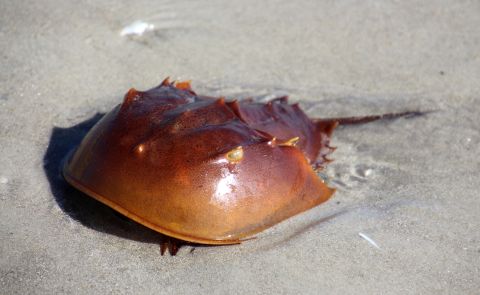
In the 1950s, a pathologist from Johns Hopkins, Frederik Bang, spent his summers working at the Marine Biological Laboratory in Woods Hole, Massachusetts. While there, he began studying the Atlantic horseshoe crab, a helmet-shaped arthropod that has been crawling across the ocean floor for 450 million years. Despite its name, the horseshoe crab is not a crab at all, or even a crustacean; its closest relatives are spiders, ticks, and scorpions.
The horseshoe crab has blood that’s blue because it carries oxygen with copper rather than iron. This isn’t uncommon in the invertebrate world. What makes the horseshoe crab’s blood valuable is what the cells do when they meet certain bacteria.
In 1956, Bang reported that when exposed to certain marine bacteria, horseshoe crabs died because their blood clotted into a solid mass. Clotting is a primitive immune defense. Horseshoe crabs have no antibodies and no white blood cells, so their blood cells, called amebocytes, detect bacterial endotoxin and instantly wall it off in a gel-like clot, trapping the bacteria before an infection can spread.
In the 1960s, Bang teamed up with hematologist Jack Levin, who worked out how to reproduce the reaction in a test tube. Levin extracted the contents of the amebocytes to create a reagent called “Limulus amebocyte lysate,” or LAL, named after the Atlantic horseshoe crab (Limulus polyphemus). When LAL is mixed with a sample that contains endotoxin, the mixture clots or turns cloudy. The test is extremely sensitive, capable of detecting endotoxin at concentrations comparable to a few grains of sugar dissolved in an Olympic swimming pool.
In 1977, the U.S. Food and Drug Administration licensed the first commercial LAL reagents, and into the 1980s the LAL test replaced the rabbit test. Today, bacterial endotoxin testing is required worldwide for injectable drugs, vaccines and other interventions. For nearly 50 years, every dose of vaccine in the U.S. supply — from routine childhood immunizations to COVID-19 vaccines — has been cleared for release by the LAL test.
The cost to wildlife
The pharmaceutical industry’s dependence on the horseshoe crab carries a price. Each year, biomedical companies collect hundreds of thousands of horseshoe crabs along the Atlantic coast; in 2024, the annual total surpassed one million. The crabs are transported to bleeding facilities, where up to 30% of their blood is drawn before they are returned to the water. Most survive. Some don’t. Fisheries managers estimate that about 15% die as a result, though published studies have reported rates ranging from 5%–30%, and research suggests bled crabs may be sluggish and less likely to spawn afterward.
The repercussions go beyond the horseshoe crab. One example is the rufa red knot, a threatened species of migrating shorebird. Horseshoe crab eggs are a critical food source for this and other migrating shorebirds, so the human effects on the horseshoe crab population have also led to effects on other species. The population of red knots has decreased by nearly 80% since the early 1980s. Since 1998, catch limits on the horseshoe crab have helped the crab population rebound, but the red knot count remains near record lows. To continue addressing the human role in this situation, deaths from biomedical bleeding of horseshoe crabs are now counted in the year’s harvest limits. The change took effect in the 2023 season.
Quality control without the horseshoe
In the 1990s, researchers Ding Jeak Ling and Bow Ho at the National University of Singapore cloned Factor C, the protein in horseshoe crab amebocytes that first senses endotoxins. Their work led to a lab-made version of the crab’s sensor, called recombinant Factor C (rFC). It is grown in cell cultures, so no crab blood is involved.
This test performed as well as crab blood in study after study, but because the official rulebooks for drug testing still named LAL as the standard, any company that wanted to use the recombinant version had to run extra studies to justify the switch. Only a few manufacturers did this. Europe moved to the rFC test in 2020, but at that time the U.S. still regarded rFC as an "alternative" method, and most manufacturers continued using LAL.
This all changed in May 2025, when the United States Pharmacopeia (USP) General Chapters published Bacterial Endotoxins Test Using Recombinant Reagents, giving recombinant reagents their own U.S. standards and holding them to the same endotoxin limits as the crab blood test. Manufacturers no longer have to prove that the method matches LAL; they only have to confirm that it works for their particular product. A handful of drug makers have converted most of their testing, decreasing the need for live horseshoe crabs. However, the rest of the industry is just getting started. Full industry conversion will take years, causing LAL testing to continue for some time. Conservation groups are actively urging manufacturers to make the switch.
Honoring the animal that kept us safe
For over half a century, the horseshoe crab has contributed immensely to modern medicine, standing guard over the safety of our injectable treatments, interventions and vaccines. As the rFC test takes over in the coming years, the horseshoe crab can finally retire from its pharmaceutical duties, hopefully increasing in numbers and playing its evolutionary role in the food chain. Perhaps the horseshoe crab — an animal that has survived five mass extinctions — can live another 450 million years.
Related resources
U.S. Pharmacopeia OKs Synthetic Alternatives to Horseshoe Crab Blood (Marine Biological Laboratory)